Best Online Plinko Strategies
On January 3, 1983, the world was introduced to a brand-new game on The Price Is Right — Plinko. During the show, a contestant would step onto the stage and face the iconic Plinko board, preparing to drop chips down a field of pegs. As the chips bounced unpredictably from side to side, they eventually landed in one of several slots at the bottom, each representing a different cash prize. But, unfortunately, this story is not about our online game.
Plinko Online is a simple yet addictive game that has gained popularity for its combination of luck, risk, and visual appeal. Unlike the physical version, in online casinos the ball doesn’t fall under the influence of gravity or real-world physics, but instead follows outcomes determined by software algorithms. Plinko is very similar to Crash, but there’s one key difference: you can’t cash out your winnings until the round is over. You can adjust just two main parameters: bet size and game difficulty. In some versions of the game, we can choose the number of lines. This is what we focused on when developing our strategies.
Strategy Plinko XY
This strategy was developed by our team specifically for the online game Plinko XY, but it can also be effectively used in any other Plinko game that allows you to adjust the number of lines.In this case, we will focus on the 15th and 16th lines, as they provide the best balance between safety and potential profit.
The idea behind the strategy is simple — you play the safest possible lines while dynamically adjusting your bet size according to a predetermined algorithm. By doing so, you ensure consistent bankroll management even if you encounter a losing streak.

How does strategy for playing Plinko XY work?
First, let’s take a look at the basic settings of the Plinko XY online game. Players can customize the number of lines in the triangle, typically ranging from 8 to 15, which affects the number of possible outcomes and the overall risk level. You can also adjust your bet size, selecting from common options such as $1, $2, $3, $5, $10, $15, $20, $30, $50, $75, or $100. The available amounts may differ depending on the currency or platform you’re using, but the principle remains the same. Additionally, Plinko XY includes difficulty settings — usually labeled as easy, medium, or hard — which change the payout multipliers and probabilities. However, for the purpose of this particular strategy, we won’t need to modify the difficulty level; instead, we’ll focus solely on the number of lines and the bet adjustment process.
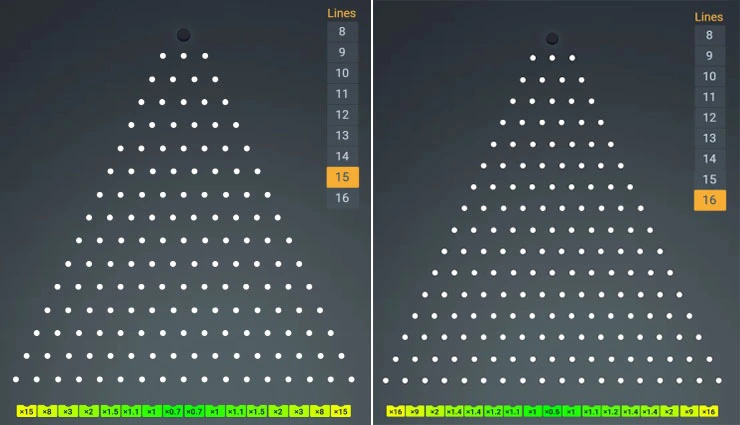
In this strategy, we suggest using only the 15th and 16th lines alternately according to the scheme (we start the first round with the 15th line):
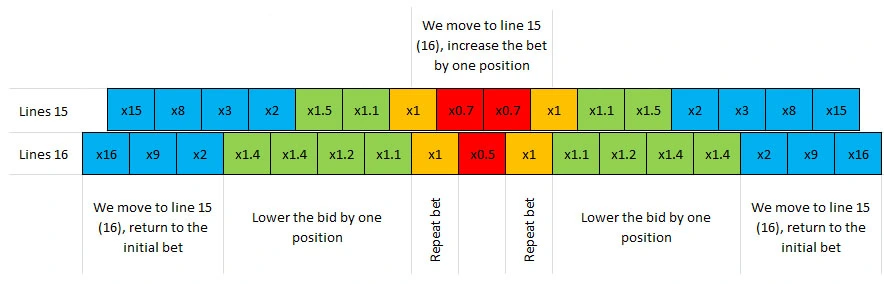
- Red zone – increase the bet and change the line.
- Orange zone – repeat the move with the current settings.
- Green zone – decrease the bet.
- Blue zone – return to the initial bet settings. In our case, $1. Change the line.

Strategy in a real game
Now let’s try applying this betting system in a real game. Reminder:
- Game: Plinko XY by Bgaming
- Lines: 15 and 16
- Available bets: $1, $2, $3, $5, $10, $15, $20, $30, $50, $75, or $100
We start with line 15 and a bet of $1:
| № | Number of lines | Bet | Win / Loss | Сoefficient | Profit $ |
| 1 | 15 | 1$ | Win | 1.1x | +0.1 |
| 2 | 15 | 1$ | Loss | 0.7x | -0.3 |
| 3 | 16 | 2$ | Win | 1.2x | +0.4 |
| 4 | 16 | 1$ | Loss | 0.5x | -0.5 |
| 5 | 15 | 2$ | Loss | 0.7x | -0.6 |
| 6 | 16 | 3$ | Loss | 0.5x | -1.5 |
| 7 | 15 | 5$ | Win | 1.4x | +2 |
| 8 | 15 | 3$ | Win | 1.1x | +0.3 |
| 9 | 15 | 2$ | – | 1x | 0 |
| 10 | 15 | 2$ | Win | 2x | +2 |
| 11 | 16 | 1$ | Loss | 0.5x | -0.5 |
| 12 | 15 | 2$ | Loss | 0.7x | -0.3 |
| 13 | 16 | 3$ | Win | 1.1x | +0.3 |
| 14 | 16 | 2$ | Loss | 0.5x | -1 |
| 15 | 15 | 3$ | Win | 1.5x | +1.5 |
| 16 | 15 | 2$ | Win | 1.1x | +0.2 |
| 17 | 15 | 1$ | Loss | 0.7x | -0.3 |
| 18 | 16 | 2$ | Loss | 0.5x | -1 |
| 19 | 15 | 3$ | Loss | 0.7x | -0.9 |
| 20 | 16 | 5$ | Win | 1.4x | +2 |
| total | +1.9 |
We provided this example to help you clearly understand the basic gameplay principle. It demonstrates how the strategy works in practice and what actions you should take during each round. However, it’s important to remember that twenty rounds are not enough to accurately evaluate the effectiveness of this approach. Short sessions can be influenced by luck, both good and bad, and don’t show the real potential of the strategy. To get a proper sense of how it performs, you need to test it in a real game environment, with real stakes and over a longer period. Only after several full cycles of play will you be able to assess its consistency, risk level, and whether it suits your playing style and bankroll management preferences.
What’s the bottom line?
The Plinko XY strategy is designed to help players bring structure and discipline to their gameplay. It reduces emotional and impulsive decisions by providing a clear, systematic approach to betting. This method has solid potential and performs well even during long losing streaks, allowing you to manage your bankroll efficiently and stay in control. However, like any betting system, it’s not foolproof — knowing when to stop is just as important as knowing when to play. Every strategy has limits, and Plinko is still a game of chance. Keep in mind that the game’s RTP (Return to Player) is around 97%, which means that, over time, the online casino retains about 3%. Play smart, stay disciplined, and treat the game as entertainment rather than a guaranteed source of income.
Even Lines – Plinko Strategy
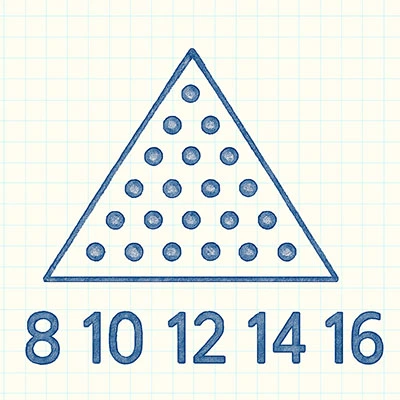
“Even Lines” is a Plinko strategy based on playing only on the even-numbered lines of the triangle. It’s not just a strategy but a specific game algorithm. The main idea is to adjust the bet amount and the selected line depending on the result obtained in the previous round. For example, if a 2.2x multiplier appears on line 8, the probability of losing in the next round increases. In this case, the algorithm suggests switching to a safer line and reducing the bet size.
The system is of medium complexity—all the necessary calculations have already been made, so players simply need to follow the schedule and place bets accordingly. The strategy is based on the Plinko game developed by Bgaming, offering a structured and balanced approach to gameplay that helps manage risk while maintaining winning potential.
How does the strategy work?
In the first stage, we will collect the information available on the Plinko game panel. The multiplier values from each payline will be transferred to a graph. We will then arrange the even-numbered lines one above the other, removing the odd lines. As a result, we obtain the following diagram:
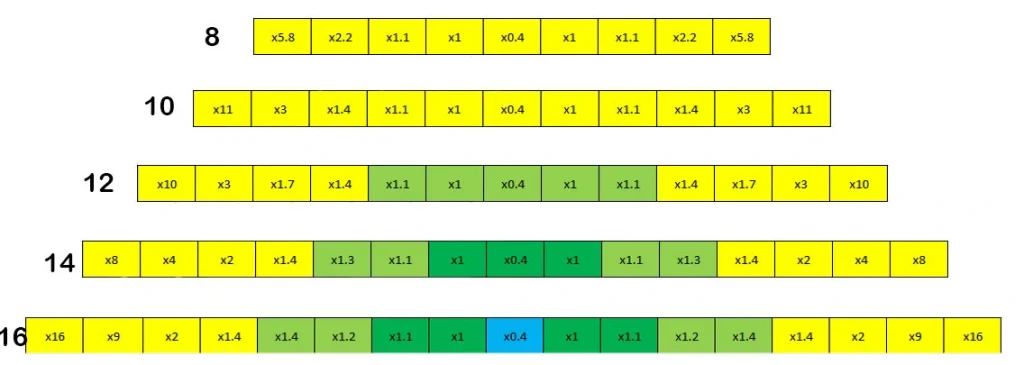
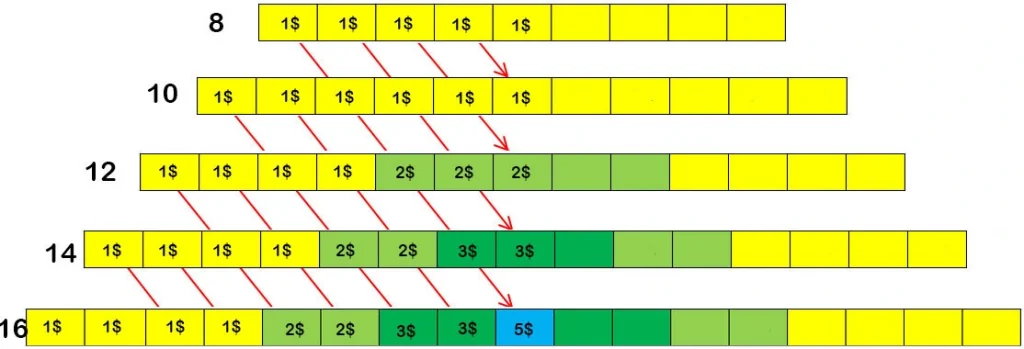
Why does each cell have a different color? If we look closely at the diagram above, we can see a similarity to the well-known Pascal’s triangle. One of the properties of this figure is that it incorporates the Fibonacci sequence.
Now let’s connect our cells according to this theory. We will fill each cell so that each diagonal represents the Fibonacci sequence: 1-1-2-3-5.
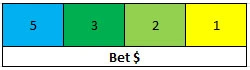
Now we know which bet corresponds to which color:
In the next step, we will arrange the even-numbered lines sequentially — 8, 10, 12, 14, 16, 8, 10, 12, 14, 16, 8, 10, 12. Then, we will draw a straight line through each cell containing a multiplier, directed toward the center of the Plinko triangle.
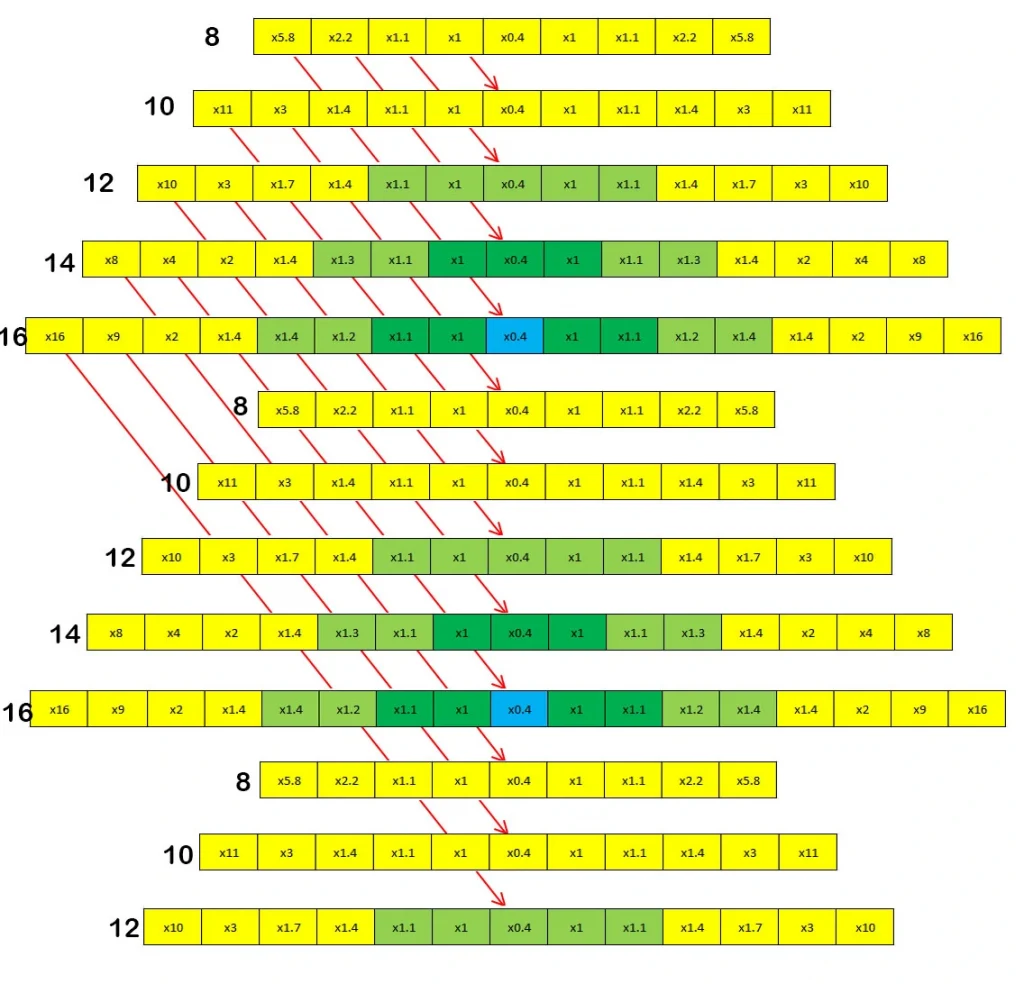
We now have a ready-made game plan—so how do we use it? It’s simple. When the ball lands on any of the listed values, we follow the arrow toward the center of the triangle. The arrow shows which line to move to in the next round. If the Plinko ball lands on the 0.4x value, we always move to line 16.

Let’s look at an example: we’re playing on line 10 of the Plinko triangle, and the ball lands on a 1.1x multiplier. The color of this cell corresponds to a $1 bet, and the arrow points to line 14. This means that in the next round, we’ll play on line 14 with a $1 wager.
Strategy in a real game
Let’s look at an example from a real game. 1Win online casino, Plinko game from Bgaming. We start the game with line No. 8 with a bet of $1.
| Number of lines | Bet | Win / Loss | Сoefficient | Profit $ |
| 8 | 1$ | – | 1x | 0 |
| 10 | 1$ | Win | 1.4x | +0.4 |
| 16 | 1$ | – | 1x | 0 |
| 8 | 3$ | – | 1x | 0 |
| 10 | 1$ | – | 1x | 0 |
| 12 | 1$ | – | 1x | 0 |
| 14 | 2$ | – | 1x | 0 |
| 16 | 3$ | – | 1x | 0 |
| 8 | 3$ | – | 1x | 0 |
| 10 | 1$ | Win | 1.4x | +0.4 |
| 16 | 1$ | – | 1x | 0 |
| 8 | 3$ | Win | 1.1x | +0.3 |
| 12 | 1$ | Win | 1.4x | +0.4 |
| 8 | 1$ | Win | 1.1x | +0.1 |
| 12 | 1$ | – | 1x | 0 |
| 14 | 2$ | – | 1x | 0 |
| 16 | 3$ | Loss | 0.4x | -1.8 |
| 16 | 5$ | Win | 1.1x | +0.5 |
| 10 | 3$ | – | 1x | 0 |
| 12 | 1$ | Win | 1.1x | +0.1 |
| total | +0.4 |
In the end, we completed 20 rounds and earned a total of $0.40. In this example, the goal wasn’t to demonstrate the profitability of the strategy, but rather to show its sequence and structure. For convenience and to save time, it’s best to print out the transition diagram so you can always have it in front of you while playing.
The Plinko strategy described here doesn’t claim to be 100% effective, but it can significantly reduce potential losses during a streak of unfavorable results. Its structure is based on principles similar to the Fibonacci system, which provides a balance between safety and stability—two essential factors for long-term gameplay.
Ultimately, “Even Lines” is more than just a ready-made plan—it’s a foundation on which you can build your own personalized strategy, adapting it to your play style and goals.
“Bet Win Repeat” – Plinko Betting System
In this review, we’ll look at an original betting system for online Plinko that is built around two simple ideas: gradually increasing the bet size and repeating the same bet after a win. The strategy is designed for players who prefer steady gameplay without the need for a large bankroll or complex calculations.
To illustrate how this works in practice, we’ll use the Plinko game from the provider Bgaming.
How does the “Bet Win Repeat” strategy work?
At the first stage, launch the game and select a 16-line Plinko field, as this setup offers a balanced combination of risk and potential payouts. The strategy is based on four fixed bet sizes: $1, $2, $3, and $5. Begin the session with the minimum $1 bet. If the round ends in a loss, increase the stake to $2 on the next drop. However, when the bet reaches $2, $3 or $5, the rules change slightly. These higher stakes may require repeating the same bet after a win instead of resetting. To better understand these transitions and when to apply each bet size, let’s take a closer look at the system presented in the table below.
| Step | Bet | Description |
| 1 | 1$ | – If we win, we repeat the bet of $1. – If we lose, we go to step 2. |
| 2 | 2$ | – If we win, we repeat the $2 bet one more time, and then (regardless of the outcome) we move on to step 1. – If we lose, we go to step 3. |
| 3 | 3$ | – If we win, we repeat the $3 bet one more time, and then (regardless of the outcome) we move on to step 2. – If we lose, we move on to step 4. |
| 4 | 5$ | – If we win, we repeat the $5 bet one more time, and then (regardless of the outcome) we move on to step 3. – If we lose, we move on to step 3. |
By following the algorithm described above, you can quickly understand how the “Bet Win Repeat” strategy functions in practice. It clearly defines when to increase, repeat, or reset a bet.
The table below shows which outcomes are considered wins and which count as losses:
| From 0.1 to 0.9 | Loss |
| 1 | Repeat bet |
| From 1.1 and above | Win |
Strategy in a real game
Let’s play 20 rounds of a real game of plinko and see how the strategy works:
| № | Bet | Multiplier | Win/Loss | Profit $ |
| 1 | $1 | 1.1x | Win | +0.1 |
| 2 | $1 | 1.4x | Win | +0.4 |
| 3 | $1 | 0.4x | Loss | -0.6 |
| 4 | $2 | 0.4x | Loss (to step 3) | -1.2 |
| 5 | $3 | 1x (Repeat) | – | – |
| 6 | $3 | 1.2x | Win (Repeat and to step 2) | +0.6 |
| 7 | $3 | 0.4x | Loss | -1.8 |
| 8 | $2 | 0.4x | Loss (to step 3) | -1.2 |
| 9 | $3 | 0.4x | Loss (to step 4) | -1.8 |
| 10 | $5 | 2x | Win (Repeat and to step 3) | +5 |
| 11 | $5 | 1.4x | Win | +2 |
| 12 | $3 | 1.1 | Win (Repeat and to step 2) | +0.3 |
| 13 | $3 | 0.4x | Loss | -1.8 |
| 14 | $2 | 1.2x | Win (Repeat and to step 1) | +0.4 |
| 15 | $2 | 1x | Repeat | – |
| 16 | $2 | 1.4x | Win | +0.8 |
| 17 | $1 | 0.4 | Loss (to step 2) | –0.6 |
| 18 | $2 | 0.4 | Loss (to step 3) | –1.2 |
| 19 | $3 | 1.4x | Win (Repeat and to step 2) | +1.2 |
| 20 | $3 | 1.2x | Win | +0.6 |
| total | +1.2 |
After completing 20 rounds of gameplay, the “Bet Win Repeat” strategy has demonstrated practical effectiveness in controlled conditions. Its biggest strength lies in flexibility, making it suitable for both beginners and more experienced players. You are not locked into rigid rules: the system can be easily adapted by adjusting the base bet, selecting a different number of lines, changing the risk level, or modifying how many times a winning bet is repeated. This allows players to tailor the strategy to their bankroll size and personal risk tolerance.
At the same time, it’s important to understand: This strategy does not guarantee a 100% win rate in Plinko or any other gambling game. Plinko outcomes are still driven by randomness, and no betting system can eliminate luck from the equation. “Bet Win Repeat” should be viewed as a structured approach to managing bets and emotions rather than a way to beat the game.
What game settings affect strategy?
The key settings in the Plinko game significantly impact your strategy development and application. The two main adjustable options are risk levels and row selection. These options directly influence the game’s volatility and potential payout range.
Risk levels allow you to select low, medium, or high risk at any time during the game. This setting determines how winning multipliers are distributed across the board. Selecting a low risk level reduces the maximum possible win, but increases the number of moderate multipliers in easier-to-reach positions, providing a steadier return. As you raise the risk level to medium or high, the probability of hitting smaller wins decreases, but the top-end multipliers in the most challenging positions increase dramatically, offering much higher rewards for greater risk.
Row selection determines how many rows, ranging from 8 to 16, are active on the Plinko board. Fewer rows (such as eight) mean nine winning spaces with a maximum payout of 29x. More rows (up to 16) expand the board to 17 winning spaces and push the potential maximum multiplier up to 1,000x your total bet (depends on the game provider).
In conclusion
The only truly 100% effective strategies for playing Plinko revolve around proper bankroll management and adopting a consistent low-risk approach. Since Plinko outcomes are determined by randomness, no strategy can guarantee consistent wins—but how you manage your money and structure your gameplay can significantly influence long-term success. Effective bankroll management means setting clear limits, determining a maximum loss threshold, and resisting the temptation to chase losses. By controlling your bets and maintaining a healthy balance, you ensure that a few bad rounds don’t wipe you out entirely, allowing for a more sustainable and enjoyable experience.
On the other hand, if you’re a high-volume player with a strong financial cushion and a higher tolerance for volatility, adopting a high-risk strategy might suit your style.