Basic Tips and Strategies for Online Poker
Online poker can seem fast, intimidating, and unpredictable for new players. With multiple tables, quick decisions, and opponents from around the world, it’s easy to feel overwhelmed at the start. However, winning poker isn’t about luck alone—it’s about making better decisions consistently. By learning a few fundamental principles, beginners can avoid common mistakes, protect their bankroll, and build confidence at the tables. A strong foundation in discipline, hand selection, position, and smart aggression can dramatically improve early results and long-term growth. Below, let’s look at 10 essential strategies and simple tips for playing online poker.
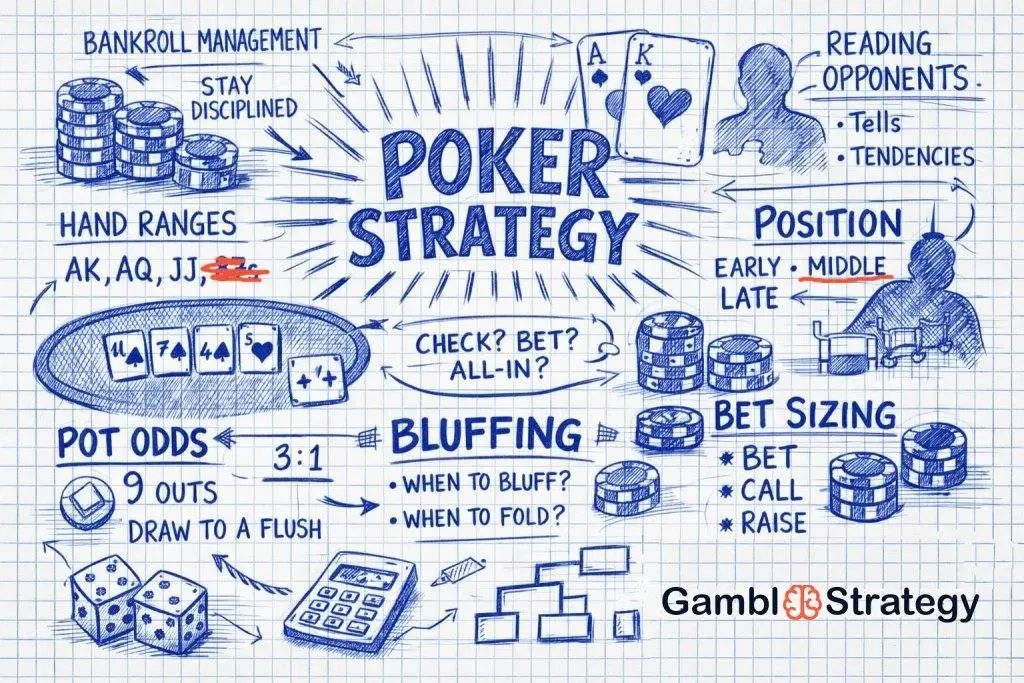
Poker Strategy – Simple Tips
If you are new to poker, then start your training with the basic strategies of the game. Learn the rules, understand hand rankings, and practice patience. Focus on solid starting hands and simple decisions. Building a strong foundation will help you improve your skills and confidence over time.
Strategy 1: Play Fewer Hands — But Play Them Boldly
In No Limit Texas Hold’em, there’s a natural cap on how many starting hands you can profitably play before the flop — even for elite players. If you enter too many pots, your chip stack will slowly disappear (unless luck happens to bail you out).
One of the simplest and quickest ways to boost your results is to build a strong preflop strategy. Creating solid preflop ranges isn’t especially hard. The real challenge is having the discipline to follow them consistently. Don’t let boredom or impatience tempt you into playing weak hands that should be folded.
The winning formula is straightforward: play a tight selection of strong and playable hands — and play them aggressively. That aggression should apply to your entire range, even speculative holdings like 7♠6♠ or small pairs such as 5♥5♣. By treating all of your hands the same way, you make it difficult for opponents to read your true strength.
When you raise, your opponents shouldn’t be able to tell whether you’re holding A-A, A-K, or 7-6. That uncertainty puts them under pressure and makes you much harder to play against.
In poker, tight and aggressive isn’t just a style — it’s a winning strategy.

Strategy 2: Never Be the First to Limp
Open-limping — simply calling the big blind as the first player to enter the pot in No Limit Texas Hold’em — is almost always a mistake. There are two key reasons to avoid it:
- First, you eliminate any chance of winning the pot immediately. When you raise, there’s always the possibility that everyone folds and you take down the blinds uncontested. By limping, you give that opportunity away.
- Second, you offer the players behind you very attractive pot odds. This increases the likelihood that multiple opponents will enter the pot, which reduces your chances of winning. The more players involved, the harder it is to come out on top.
The one exception is when other players have already limped into the pot. In that case, over-limping can make sense. You’re getting a good price to see the flop, and if you’re holding a speculative hand, you may be able to connect strongly and win a sizable pot.
Strategy 3: Semi-Bluff Your Draws with Confidence
If you want to consistently win at No Limit Texas Hold’em, you must learn how to bluff — but you also need to do it wisely. Poorly timed or excessive bluffs are one of the quickest ways to drain your stack. The key is keeping your bluffing frequency under control.
The simplest way to do that is to let your cards guide your decisions. Instead of bluffing with complete air, choose hands that have the potential to improve on later streets. Straight draws, flush draws, or even hands with one or two overcards to the board are ideal candidates.
These types of hands give you a backup plan if your bet gets called. Even if your opponent doesn’t fold, you still have a chance to hit a strong hand.
That’s why these plays are known as “semi-bluffs” — they combine fold equity with real improvement potential.
If you’re new to the game, avoid bluffing with pure nothing before the river. Focus on semi-bluffs instead, where you have equity working in your favor along with your aggression.
Strategy 4: Fast-Play Your Big Hands to Maximize Value
There’s nothing more frustrating than watching a player check their flopped nut flush all the way to the river — only to sheepishly reveal a monster after their opponent checks behind. Slow-playing too often is a common mistake, usually driven by fear of scaring opponents out of the pot.
In reality, strong hands should usually be played aggressively. Betting and raising helps you build the pot and protect your equity. By putting money in early, you charge opponents to draw and ensure you get paid when you’re ahead.
That doesn’t mean you must always bet or raise your big hands after the flop in No Limit Texas Hold’em. Checking can make sense in certain situations:
- When it’s very unlikely you’ll be outdrawn
- When there are few scare cards that could kill your action on later streets
- When your opponent’s range consists mostly of hands with little or no showdown value
Still, when in doubt, lean toward aggression. Bet for value — or check-raise if you weren’t the preflop aggressor. Sure, it can be disappointing when your opponent folds, but that’s far better than giving a free card that costs you the pot or missing out on value you could have captured.
In most cases, fast-playing wins more money than fancy slow-playing ever will.
Strategy 5: Defend Your Big Blind
The big blind is unique because you already have one blind invested in the pot. In No Limit Texas Hold’em, this means that when facing a raise from this position, you’re getting better pot odds than players in other seats. Think of it as a built-in discount.
Because of that discount — and because you’re the last player to act before the flop — you can profitably defend with a wider range of hands than you could from other positions. That doesn’t mean calling with junk like 9♠5♦, but it does make borderline hands such as K♣9♦ or Q♥6♥ reasonable calls in many situations.
How wide you should defend depends on several key factors:
- Raiser’s position – Tighten up against early-position opens and defend more liberally against late-position raises.
- Number of players involved – If others have already called, lean tighter and favor hands that perform well in multiway pots.
- Raise size – The larger the raise, the stronger your calling range should be. Smaller raises allow you to defend more hands.
- Stack sizes – When stacks are short, prioritize high-card strength and reduce speculative calls. Deeper stacks allow for more flexibility.
Other dynamics matter too — such as how often your opponent continuation bets after the flop — but these four factors form the foundation of a solid big blind defense strategy.
Strategy 6: When in Doubt, Fold
One of the clearest differences between an amateur and a professional in No Limit Texas Hold’em is the ability to let go of a decent hand — even something as strong as top pair — when the evidence suggests it’s beaten.
It sounds straightforward, but in reality, it’s extremely difficult. Human nature works against us. We’re curious, competitive, and wired to seek closure. Folding means giving up your shot at the pot — and giving up the chance to see what your opponent was holding.
Yet calling too often, especially in marginal spots, is one of the fastest ways to lose money (second only to reckless bluffing). If you’re stuck between calling and folding and genuinely unsure, choosing the fold will usually save you chips in the long run.
Pro Tip: When you make a tough fold, write down the details of the hand after your session. Review it later to evaluate whether your decision was correct. Studying and discussing close spots like these is one of the most effective ways to sharpen your skills and plug leaks in your game.
Strategy 7: Apply Pressure When Your Opponent Shows Weakness
Many players don’t balance their checking range properly. When they check, they often hold hands that can’t withstand much pressure. As a result, repeated aggression will force them to fold more often than they should. This is the ideal spot for the “bluffing with nothing” scenario mentioned earlier.
In a heads-up pot in No Limit Texas Hold’em, clear signs of weakness — such as checking both the flop and the turn — create an opportunity to take control. When your opponent declines to show strength, you can respond with a well-timed, aggressive betting strategy.
Of course, you should continue betting your standard semi-bluffs. But in these situations, you can also expand your range to include some pure bluffs — preferably hands that contain strong blocker effects, reducing the likelihood that your opponent holds a premium hand.
When weakness appears, pressure pays.
Strategy 8: Play Strong Early in Tournaments — Don’t Obsess Over Survival
In tournament play in No Limit Texas Hold’em, many players make the mistake of focusing too much on preserving their stack in the early stages. In reality, the beginning of a tournament is not the time to play scared.
To make a deep run — and especially to finish in the money — you’ll usually need to double or even triple your starting stack, often more. That kind of growth doesn’t happen by folding your way through the early levels. Instead, you should aim to play fundamentally sound, disciplined, and aggressive poker to accumulate chips while blinds are small and stacks are deep.
A survival-focused approach only becomes appropriate later on — particularly when you’re short-stacked near the money bubble or approaching a significant pay jump. That’s when preserving your stack gains strategic importance.
Early on, build. Later, protect — if the situation demands it.
Strategy 9: Play Only When You’re in the Right Mood
Poker should always be enjoyable, whether you play casually or professionally. You’ll perform at your best when you’re in a positive mindset, so it’s important to sit down at the table only when you feel mentally ready for such a demanding game.
If you start feeling frustrated, tired, or angry, it’s best to end your session immediately. Walking away in those moments can often save you a significant amount of money. Remember, the game will still be there tomorrow.
Author Tip: Before starting a session, imagine going all-in on the very first hand and losing your entire stack. If that possibility doesn’t bother you, it’s a good sign you’re ready to play your A-game for an extended session. But if the thought of losing a full buy-in right away feels unbearable, it may be wiser to skip the session.
Strategy 10: Choose the Right Games
“If you can’t spot the sucker in your first half hour at the table, then you are the sucker.”
This line, famously said by Mike McDermott in Rounders (1998), is just as true today as it was then. To win at poker, you need to play against opponents who are weaker than you.
Think of it this way: even if you’re the ninth-best poker player in the world, you’ll likely be the strongest player at almost any table. But if you sit down with the eight players who are better than you, suddenly you’re the one at a disadvantage.
Always put yourself in situations where your chances of winning are highest. That’s why leaving your ego at the door is so important in poker.
In general, you need to be better than at least half the players at the table to maintain a positive win rate. And if you want to maximize your profits, you should actively seek out games with the weakest competition.
Checklist for a Good Poker Game:
- At least one player frequently limps into pots.
- Many hands go to multiway pots.
- Re-raises are either extremely rare or happen very frequently.
If two or more of these boxes are checked, you’re likely in a very profitable game. If none apply, it may be wise to leave and find a softer table—unless you’re deliberately looking to challenge your skills.
Author Tip: For online poker, take advantage of the table statistics most platforms provide. Look for tables with a high average pot size and a high percentage of players seeing the flop. Many beginners overlook this simple but powerful strategy while they’re still learning the basics of the game.
Best poker strategy books
The best poker strategy books combine timeless fundamentals with adaptable thinking, helping players navigate both live and online games. Among the classics, The Theory of Poker by David Sklansky remains essential. It introduces core concepts such as pot odds, implied odds, and the fundamental theorem of poker—ideas that apply across nearly every variation of the game. For serious students, it builds the intellectual backbone of strategic decision-making.
Another influential work is Harrington on Hold’em by Dan Harrington. This series is particularly valuable for tournament players, explaining stack sizes, position, and endgame pressure with clarity and structure. Harrington’s logical approach makes complex scenarios manageable for intermediate players seeking consistency.
For a modern, mindset-driven perspective, The Mental Game of Poker by Jared Tendler addresses tilt, confidence, and emotional control—areas often overlooked but crucial for long-term success. Technical skill means little without psychological stability.
Meanwhile, Doyle Brunson’s Super/System remains a legendary contribution. Though some strategies are dated, its aggressive philosophy reshaped how players think about pressure and initiative.
Together, these books teach mathematics, psychology, discipline, and aggression. The best poker education comes not from memorizing hands, but from understanding principles—and these books provide that enduring foundation.